Showing posts with label Nature. Show all posts

Tuesday, August 17, 2010

Gardening with nature in mind

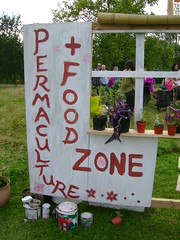
Permaculture & Food ZoneImage by London Permaculture via FlickrMimicking Nature to Feed the Masses
The second method is permaculture gardening, which is an interdependent system where a large variety of complimentary plants are strategically located for the benefit of the entire garden. This design system is brilliant for urban micro-farms, kitchen gardens, self-sufficient homesteads, and even large scale family farming. The philosophy of permaculture gardening is to recreate nature in a profound way to produce chemical-free food.
Permaculture works something like this; you design an entire edible habitat based on the natural capital of your setting. Then, place plants to methodically balance the soil, water, and pests. For instance, a nitrogen fixing plant may be planted next to a nitrogen hungry plant, which may sit next to an ornamental that deters predators, and so on. Permaculture is also a closed circle philosophy where all resources are optimized though conservation and recycling. The immense food yields per acre are astonishing when using permaculture methods and the results are also drawing many newcomers.
Many homesteaders have utilized these techniques for years before Bill Mollison coined the term “permaculture”in the 80s. However since then, the definition of permaculture has grown to encompass sustainable design systems for all aspects of our existence – agriculture, water, housing, business, community, and wellness.
Now that conventional agriculture methods that depend on cheap infinite oil are proving to be unsustainable at best, permaculture’s popularity is exploding. Numerous businesses, institutes, courses, and internships are popping up to spread nature’s gospel.
Learning about these methods has given me new-found optimism about living in a sustainable way as humanity progresses. These techniques can truly provide a future of what has been previously called an oxymoron – Sustainable Abundance.
Sustainable Abundance - love that term.  No harm gardening.
Enhanced by Zemanta

Friday, July 2, 2010

Balance

Organic Farming's Balanced Ecosystems Naturally Control Pests Better Than Monoculture

There are myriad advantages that organic farming has over chemical agriculture, from the health of the land to the quality of your food. Now a new study in the journal Nature details one aspect of that: The way in which the more balanced nature of ecosystems in organic farming support a greater variety of insects, preventing any one pest from dominating.

Researchers from Washington State University examined insect pests and their natural enemies in potato crops and found that in organic fields the most abundant insect species accounted for as little as 38% of a field's insect predators. In conventional fields one species might be as high as 90% of all species.

In their potato test plots, they used Colorado potato beetles, and four insect species and three soil pathogens that attack the beetles. When the predators and pathogens were more balanced with the potato beetles the researchers found "significantly less potato beetles" and "we'd get bigger plants."

Washington State's David Crowder: "I think 'balance' is a good term; when the species are balanced, at least in our experiments, they're able to fulfill their roles in a more harmonious fashion." (Science Daily)
A balance in nature - nicely said. But this just goes so far some times. I used to think that my garden can feed my family and local wildlife - so no fences. This worked great until one year the local deer felt the need to shift the "balance" in their direction. Hence - fences erected and working!
Now as long as the insects follow the balancing rules I will be very very happy and willing to lose a few leaves of chard...
Enhanced by Zemanta