Last week Colleen brought us the story of a woman in Michigan who is facing jail time for planting a garden. Sadly, this type of heavy-handed by-the-letter enforcement of bylaws exists at the same time as people embrace urban agriculture as a viable source of high quality nutrition. A man in Lanztville, British Columbia is facing a similar battle with the local government after converting his 2.5 acre "residential" lot from a gravel pit into a thriving organic farm. His refusal to "cease all agricultural activity" could land him six months in jail.Breaking the law by planting a garden. Strange but true. I love breaking the law!
Acting on a single complaint from a disgruntled neighbor the regional district sent a letter to Dirk Becker giving him 14 days to "remove the piles of soil and manure from the property." The quoted bylaw states that property owners will ensure their property doesn't become or remain "unsightly". Specifically this refers to "the accumulation of filth, discarded materials or rubbish, which includes unused or stripped automobiles, trucks, trailers, boats, vessels, machinery, mechanical or metal parts." Admittedly, it can be argued that, to some, a manure pile could be considered "filth". But, considering how Becker regenerated his 2.5 acres
Showing posts with label Garden. Show all posts
Showing posts with label Garden. Show all posts
Tuesday, July 12, 2011
I'm a criminal - Part II
British Columbia Man Faces Six Months in Jail for Growing Food

Tuesday, May 3, 2011
Don't let the neighbors catch you
Garden Mulch Makes the Simplest Composting Toilet of All

From peeing in public to plush and fragrant composting toilets, there was a time when I was writing an awful lot about pee and poop. It's been a while since I visited this important topic, but as I was going through my morning routine today, I thought I should share my ingenious design for a composting toilet with the world.Great for the garden and a great way to mark your territory, Let those deer know they are in your domain now.
Garden mulch.
Urine Contains Valuable Nutrients
Whether we are talking about gardening with urine or large-scale urine separation for fertilizer, we've already covered many ways to utilize our bodily wastes in the fight against peak fertilizer.
Urine as Fertilizer Requires Processing
But, generally speaking, these systems involve either a major infrastructural investment, or they involve some kind of processing at home—whether it is a humanure toilet, peeing on the compost heap, or at least diluting your pee before using it as a direct fertilizer. Using urine directly on your plants can be too strong, and unless it binds with some form of carbon the nutrients are not readily available to plants and can easily be washed away.
The Easy Way to Use Urine in the Garden
But, like many gardeners I already have a perfect source of carbon spread right around my plants—mulch. So while I still pee in my compost heap from time to time (stop me if this is TMI), I have also taken to peeing any and everywhere where we have a carbon-based mulch applied around plants. The idea is that, over time, the mulch will break down anyway, but with added nutrients from human urine it will not just provide organic matter to the soil, but a dose of valuable nutrients with no need for turning the compost heap or spreading out the end result. (Remember that not all mulches are created equal—the New York Times ran an illuminating piece on the environmental impact of cypress mulch some time back.)
Just one more trick in the lazivore gardener's tool box. Does anyone else pee on their mulch?
Wednesday, April 13, 2011
Weeds as signs
What Your Garden's Weeds are Trying to Tell You

The best way to learn about your soil's health is to get a soil test through your local cooperative extension service or at a local nursery. However, there are a few simple things you can do to get a general idea about your soil's health. One of the best ways to find out more about your soil is to observe what's growing well in it.My "culprit":
Different weeds thrive in different conditions. Note that we're not talking about one or two weeds here. If you're seeing several of the same weed in an area, that can give you a good general idea of what type of conditions you have in that spot.
High fertility and food source - I always use purslane in salads. So can these really be called a weed?
- Purslane: Purslane's thick, fleshy leaves are actually edible and a very good source of omega-3 fatty acids, iron, and calcium. If it's thriving in your garden, you likely have soil that is high in fertility.
Monday, February 7, 2011
Job opening
Buckingham Palace Seeking Environmentally Savvy Gardener

Are you a green-minded person with a green thumb? You might want to check out the job listings at Buckingham Palace. "The £15,000-a-year post entails maintaining the 42-acre garden 'to the highest standards' and recycling 99 per cent of the waste - even from the Royal Mews stables. The successful applicant must also be able to maintain shrub, herbaceous and rose borders in line with 'good organic horticultural practices' and 'to assist in the development of the wildlife in the gardens'," reports The Telegraph, which lists has the details.Wonder if they'd pay relocation fees?
Wednesday, October 13, 2010
My future?
Empowering Backyard Growers to Sell Their Produce

With the dropout economy fueling food entrepreneurship, and backyard farming (and even slaughter) taking off around the world, it makes sense to develop new and innovative ways for micro-growers to get their products to market. A New Zealand start up is hoping to unite farmers, micro-farmers and gardeners, and offer their produce through one easy to use site.Anyone in the market for tomatilloes?
At first glance Ooooby looks a little like the Veggie Trader site that Jasmin reported on a little while back. But Ooooby seems to take the concept a little further. The group is already selling produce from gardeners and backyard growers at a regular farmers market stand, and it is enabling barter and swapping among grower members. Now a small proportion of the backyard produce is also making it into the group's veggie box deliveries, which also feature produce from local and organic farmers—as well as some produce, like bananas, from further away.
Of course CSAs and veggie box delivery schemes are nothing new. But it is very cool to see a group specifically working to harness the growing power of backyard farmers.
Tuesday, August 17, 2010
Gardening with nature in mind
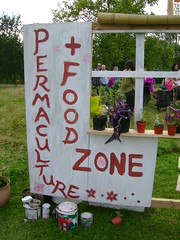 Image by London Permaculture via FlickrMimicking Nature to Feed the Masses
 The second method is permaculture gardening, which is an interdependent system where a large variety of complimentary plants are strategically located for the benefit of the entire garden. This design system is brilliant for urban micro-farms, kitchen gardens, self-sufficient homesteads, and even large scale family farming. The philosophy of permaculture gardening is to recreate nature in a profound way to produce chemical-free food.Sustainable Abundance - love that term. No harm gardening.
Permaculture works something like this; you design an entire edible habitat based on the natural capital of your setting. Then, place plants to methodically balance the soil, water, and pests. For instance, a nitrogen fixing plant may be planted next to a nitrogen hungry plant, which may sit next to an ornamental that deters predators, and so on. Permaculture is also a closed circle philosophy where all resources are optimized though conservation and recycling. The immense food yields per acre are astonishing when using permaculture methods and the results are also drawing many newcomers.
Many homesteaders have utilized these techniques for years before Bill Mollison coined the term “permaculture”in the 80s. However since then, the definition of permaculture has grown to encompass sustainable design systems for all aspects of our existence – agriculture, water, housing, business, community, and wellness.
Now that conventional agriculture methods that depend on cheap infinite oil are proving to be unsustainable at best, permaculture’s popularity is exploding. Numerous businesses, institutes, courses, and internships are popping up to spread nature’s gospel.
Learning about these methods has given me new-found optimism about living in a sustainable way as humanity progresses. These techniques can truly provide a future of what has been previously called an oxymoron – Sustainable Abundance.

Saturday, August 14, 2010
Tire Pond
Fish pond from tractor (or car) tires

There are many Instructables (and other Web pages) on using tires (tyres, but I'll use the other spelling) for gardens, which I have been very motivated by, but here is how I used two tractor front tires to build a fish pond . The original inhabitants were our two surviving bronze goldfish, who after years inside, finally bred in the pond and had three babies.Great instructions for creating a unique pond. Wonder if this can be used to raise some tilapia?
This pond was built in December 2007 in the earlier days of my turn-the-front-lawn-into-garden project.
The tires came from a park mowing tractor so are wider than normal tractor tires, giving extra height to the pond. You can usually pick these up free, in New Zealand anyway, from large tire repair and supply workshops: mine came from the parks maintenance company I work for - free disposal for them and free supply for me!
Saturday, August 7, 2010
Post vacation Gardening
A week away but not too bad in the garden - of course spent a few hours weeding.. My bush beans are kaput (a technical term) but the pole beans have taken off. Picked a mess (another tech term) of pole beans and cooked them for supper - a few were a little past prime and not for my dilly beans.
Pulled and shelled black beans, cattle and pinto beans - enough for two meals or a bunch of soup pots. Pulled about a dozen tomatoes. Just lost a few cherries that fell off. Pulled some tomatillos as well - what to make with them?
The three plants that took my absence the worst were the cukes (still will get some more I hope), the cousa squash (more to come I hope) and the kabocha squash (have just a few nice sizes to pick). Also not taking my absence too well - along with the heat and dry weather - were the potato plants. Still there and growing but needs some TLC. It looks like some deer feasted on the leaves as well. Didn't think they would feast on the potato plants but their chomping should not be a major issue.
Everything else - beets, carrots, turnips, rutabagas, parsnips, kale.. look great and should supply a nice stock for some fall/winter soups and meals.
Love vacation but it is great to be back in the garden.
Pulled and shelled black beans, cattle and pinto beans - enough for two meals or a bunch of soup pots. Pulled about a dozen tomatoes. Just lost a few cherries that fell off. Pulled some tomatillos as well - what to make with them?
The three plants that took my absence the worst were the cukes (still will get some more I hope), the cousa squash (more to come I hope) and the kabocha squash (have just a few nice sizes to pick). Also not taking my absence too well - along with the heat and dry weather - were the potato plants. Still there and growing but needs some TLC. It looks like some deer feasted on the leaves as well. Didn't think they would feast on the potato plants but their chomping should not be a major issue.
Everything else - beets, carrots, turnips, rutabagas, parsnips, kale.. look great and should supply a nice stock for some fall/winter soups and meals.
Love vacation but it is great to be back in the garden.
Tuesday, July 27, 2010
De-lawn your yard
A Call for an End to Primpy Lawns

Despite signs of progress, the de-lawnification of America is going pretty slowly. Although the green and alternative press is bursting with stories of backyard gardens, frontyard gardens, rain gardens, prairie restorations, and other turf-free options, it’s clear from mere observation that most American homeowners still think that a flawless, chemically treated monoculture lawn is the way to go.I too love my clover, violets, dandelions.... I like even more my trees, flower gardens, veggie gardens, fruit bushes and moss gardens. Now if I can convince the family that the bocce court lawn should become a garden...
Reggie McLeod, the publisher of Big River magazine, which covers the Upper Mississippi, is fed up with it. “This column may get me in more trouble than any other that I have written, but I’m going public with my challenge to primpy lawns,” he writes in his editor’s note in the July-August Big River:
I have never understood why people feel compelled to dump toxic chemicals and fertilizers on their lawns, then drench them with water, which, by the way, washes a lot of the chemicals and fertilizers into the groundwater or into the sewers, both of which lead to the lakes, streams, and rivers.
And then? Well, this massive load of nitrogen and phosphorous create algae blooms that degrade water quality and wildlife habitat. McLeod concedes he once bought into the green-lawn myth, as a teen selling Scott’s products door to door. But he’s now an unrepentant hands-off groundskeeper: He has a lawn, but lets it do its own thing:
To the untrained eye it may appear that I have a crappy lawn, but I’m proud of it. I enjoy the violets, clover, and even the dandelions. I have never put a drop of herbicide, insecticide, or fertilizer on any of my lawns in my adult life. I hope that I have lowered the bar for my neighborhood.
We’ll need brave warriors like McLeod to combat the deeply rooted perception that pristine green lawns are a mark of an enlightened civilization. “The American lawn now represents a serious civic problem,” Elizabeth Kolbert wrote two years ago in the New Yorker in an article on what she called the “lawn-free movement.” But I haven’t exactly seen this movement take hold in mid-America: Traveling alongside McLeod’s beloved Upper Mississippi, I see lots of people straddling their lawn tractors on vast green expanses, baking for hours in the summer sun so they can carve out their bit of perceived paradise.
But you know what? In paradise, they don’t mow the lawn.
Sunday, July 18, 2010
Wishing summer away?
Pulled out the lettuce and two cousa squash plants. The squash was replaced with kale seeds. The lettuce area will be planted with a fall crop of greens.
The kabocha and butternut squash are growing great. Pumpkin and acorn are slowly getting there. I think next year we'll forget the pumpkin and acorn and just plant the whole back with kabocha.
So not really wishing a season away, but just planning ahead. Planning for the veggie stew with potatoes, kale, parsnips, turnips, carrots...It was my staple last fall and will be this year as well. But now it will be fortified with my own-grown potatoes and dried beans.
It has been a very good year for the garden so far. Though more watering this year than last.
But the yellow jackets are not treating me as well. Another sting - this one on my left hand. Let's see if this one swells my hand to three times the size.
The kabocha and butternut squash are growing great. Pumpkin and acorn are slowly getting there. I think next year we'll forget the pumpkin and acorn and just plant the whole back with kabocha.
So not really wishing a season away, but just planning ahead. Planning for the veggie stew with potatoes, kale, parsnips, turnips, carrots...It was my staple last fall and will be this year as well. But now it will be fortified with my own-grown potatoes and dried beans.
It has been a very good year for the garden so far. Though more watering this year than last.
But the yellow jackets are not treating me as well. Another sting - this one on my left hand. Let's see if this one swells my hand to three times the size.
Monday, June 28, 2010
Gardens as Teachers
How Gardening Teaches Patience


The thing about gardening is that you realize you can't rush things. A seed takes a certain amount of time to sprout, no matter what you do. A plant or tree takes a certain amount of time to grow, flower, or bear fruit, no matter what you do. No amount of chemicals or technology can make it go faster. And that's totally OK! Can you imagine? That there is still something in our world today we can't force to go faster? Crazy! Crazy good.This article reminded me of "Gardening at the Dragon's Gate: At Work in the Wild and Cultivated World."
Even weeding is a good teacher of patience. It's always intimidating to look at a giant patch of weeds and realize that it's up to you to take them out. Sure, go ahead and spray some Roundup--poison the planet and your children (born or unborn). But you are missing the best part of weeding! Here is what I do: I take a blanket and a basket, and I get comfortable sitting on the ground. I time it so that it's either early or late in the day, and preferably in the shade, and I start at one end and keep going (moving the blanket along with me) until I am done.
What's so great about that? Well, for one thing, you start to see your garden up close. It's amazing all the living things you come across. You notice plants that weren't there before, and you can decide to let some stay just for fun. But most important, you have time to think. Time to let your mind wander while your hands are busy. Suddenly, you have ideas, insights, happy thoughts, resolution to problems. So when the weeding is done, not only do you have a great sense of accomplishment and your garden looks tons better, but your mind has been weeded too. That just can't be rushed.
Perhaps a more appropriate subtitle would have been Zen and the Art of Horticulture Maintenance, since Johnson infuses every aspect of gardening with the philosophy that has been her guiding light for more than 30 years. A Zen Buddhist master, Johnson has served as head gardener for San Francisco’s Green Gulch Farm Center, a place of exceptional tranquility and vibrancy where her daily devotional meditation practices became as essential to the health and productivity of her gardens as they were to her body and soul.It is not only the "eating" side of the garden that I enjoy, it is the "spiritual" side that drives me to be in the garden every day - pull weeds, talk to my plants, nurture...
Tuesday, May 11, 2010
King Radish
 Image via Wikipedia
And you thought it was for salads only.OF all the things you can do with a radish — slice it into salads, chop it into salsa, shred it into slaw or, better, top it with a thick layer of sweet butter and a sprinkling of flaky sea salt — the last thing I’d thought to do was cook it.
But last spring I started noticing roasted radishes sprouting up on menus all over New York City. Even the fancy takeout shop near my house was offering them every now and again. Clearly, there was a reason to cook a radish, and I wanted in.
So I gave it a try, roasting a bunch of halved radishes in a hot oven with plenty of butter and lemon juice.
One mouthful, and I immediately got the appeal. Instead of spicy, crisp and crunchy, these radishes were sweet, succulent and mellow, vaguely like turnips but with a softer bite.
I continued to cook radishes all season long, pan roasting them instead of oven roasting when the weather became too hot. I usually ate them for lunch sprinkled with feta cheese and herbs, or sometimes left them naked but for extra sea salt and cracked black pepper.
Then winter came. Tender radishes vanished from the farmers’ market, and I forgot all about them, until a friend served them at a dinner party in January. They were prepared raw, slathered with an anchovy-and-garlic-laden bagna cauda sauce. The combination of garlic, anchovy, butter and tangy radish hit the exact umami notes that I always crave. So I knew that the moment radishes came back into season I’d try the same thing.
At last I had the chance when they reappeared at the farmers’ market last month. While the radishes were roasting, I stirred together a quick sauce similar to bagna cauda. Then I piled the soft radishes and pungent sauce onto toasted crusty bread, crostini style.
The toast sopped up the sauce, making it possible to get an even greater garlicky sauce-to-radish ratio in each bite than without the spongy cushion. It also made the radishes seem like more of a meal than my usual bowl of warm salad.
Sometimes the most familiar ingredients are the ones with secret lives.
Sauteed radish with the tops is great. You'll find a reason to grow them more often!
![Reblog this post [with Zemanta]](http://img.zemanta.com/reblog_e.png?x-id=f7f02b0c-6ad7-416e-8303-afb3e8417752)
Monday, May 10, 2010
Front gardens
Edible Estates
![Reblog this post [with Zemanta]](http://img.zemanta.com/reblog_e.png?x-id=a1c718ea-91c5-48dd-8c02-d78498ff547d)
Have we convinced you yet that there are better things to do with the water, equipment, fuel, energy and pesticides that go into maintaining a traditional lawn? If we haven't, add this voice into the mix: Edible Estates: Attack on the Front Lawn by Fritz Haeg. This expanded second edition won't overwhelm you with how-to minutiae or examples of perfection you could never hope to achieve on your own. Instead, you get a steady stream of inspiration: region-by-region prototypes, planting calendars, yes, but also full-blown essays by sustainability supporters such as Michael Pollan and Lesley Stern.My garden out of necessity is in my front yard. And the lawn spaces are not what my neighbors would call grass. Think moss, dandelions, violets...
"By attacking the front lawn," writes the author, "an essential icon of the American Dream, my hope is to ignite a chain reaction of thoughts that question other antiquated conventions of home, street, neighborhood, city, and global networks that we take for granted. If we see that our neighbor’s typical lawn instead can be a beautiful food garden, perhaps we begin to look at the city around us with new eyes. The seemingly inevitable urban structures begin to unravel as we recognize that we have a choice about how we want to live and what we want to do with the places we have inherited from previous generations. No matter what has been handed to us, each of us should be given license to be an active part in the creation of the cities that we share, and in the process, our private land can be a public model for the world in which we would like to live."
Will we be able to overcome our American preoccupation with lawns that project the right image to the neighbors? It's a major shift for many—but perhaps planting a book like Edible Estates on your neighbor's coffee table might inspire more fruitful plantings in the front yard.
Hey I like it.
Last frost?
How to Cover Plants for Frost Protection
![Reblog this post [with Zemanta]](http://img.zemanta.com/reblog_e.png?x-id=6cb61ef6-bb29-4ddb-9e5e-f0a7ef8bcdef)
Bed sheets and newspapers over my tomatoes, peppers and potatoes. Lettuce, beets, bok choi - you guys have to fend for yourselves but I know you guys can take it. Basil - you are nestled snug and warm in the garage.A fabric covering will allow moisture to escape but will still protect plants from frost by preventing the freezing air from coming into direct contact with the moisture. Bed sheets work well for covering large plants and shrubs, as well as young sprouts. Newspaper can be used on low-growing foliage, but won’t stay on top of larger plants well.
What we do for our gardens. Covering plants in the dark guided by flashlights. Waking early, before work, to check on the garden and remove the covers.
Thursday, May 6, 2010
Problem? E Coli
Lettuce in 23 states recalled over E. coli fears
![Reblog this post [with Zemanta]](http://img.zemanta.com/reblog_e.png?x-id=35de3f73-03e7-4789-96ec-9cd29d54f555)
An E. coli outbreak possibly linked to tainted lettuce has sickened at least 19 people in Ohio, New York and Michigan, including students on at least two college campuses, prompting a recall throughout much of the country.Solution: Grow your own!
Freshway Foods of Sidney, Ohio, said it was recalling romaine lettuce sold in 23 states and the District of Columbia because of a possible link to E. coli.
The FDA is focusing its investigation on lettuce grown in Arizona as a possible source for the outbreak...
Monday, March 1, 2010
Greener Gardens - Greener Souls
 Image via Wikipedia
The frog was not talking about his garden when he sang "it's not easy being green" he was talking about his soul. Cultivating a green soul is not always easy but it is more worth the doing than just about anything I know.Read the article for some tips too.
When it becomes our goal to nurture nature we begin to cultivate a relationship that supports our entire ecosystem.
Remember, if it is poisoning the frogs, birds and insects, then it is probably poisoning us and our kids. So this year take a vow to ditch the pesticides and herbicides and grow a lawn and garden that the frog would be happy to sing his heart out in.
I love the idea of "cultivating a green soul." Green is not measured with what we buy, how many green gadgets we have. It is how we view nature, Mother Earth, our life...
![Reblog this post [with Zemanta]](http://img.zemanta.com/reblog_e.png?x-id=958007e2-27fc-4b9e-b7df-9650005450d3)
Tuesday, February 16, 2010
It's a sign
 Image via Wikipedia
Soil is as essential a natural resource as air and water. Yet we’re running out of healthy, fertile dirt at an alarming rate. One man’s odyssey to retrace and reduce his soil footprint.The sign?
At the heart of Jeavons’ system is a maniacal focus on composting. Now, when he uses the term he is not merely referring to the quaint re-circulation of leftover bits of lunch. Jeavons recommends that a gardener devote a full 60 percent of planting space to growing crops the principal purpose of which is to add biomass to compost piles. Cereal grains, giant overgrown daikon gone to seed and six-foot-tall (two-meter-tall) cardoons are among the many plants born to die and rot un-tasted, cut down and fed through the system, capturing more carbon with each generation.
Yes, you read that correctly. I have been composting my own dung in my backyard. Like many advances in human technology, the hegemony of the flush toilet is not forever, and as the planet has grown increasingly crowded, more people are reevaluating its merits. Every day, millions of tons of potential soil nutrition are sent downstream to treatment plants, where they are mixed with industrial effluent and spent pharmaceuticals, chlorinated, dechlorinated and condensed into a material that the industry likes to call “bio-solids,” but everyone else prefers to call by its old name: “sludge.” Most of this sludge ends up covering over the layers of garbage in landfills, contributing to the aforementioned methane problem. Then there is the dubious practice of soiling and cleaning our drinking water in an increasingly thirsty world.Yes, there it was staring at me. The humanure concept again. A sure sign that this may be my spring project. The muse is speaking to me.
On top of this, the nutrients contained therein are effectively lost forever. According to John Jeavons, all but a tiny percentage of the minerals necessary to produce a year’s worth of food for one person can be found in a year’s worth of that person’s waste.
My first step was to get a copy of The Humanure Handbook, published in 1995 by Joseph Jenkins, a slate roofer in western Pennsylvania. The Jenkins method is the model of simplicity. One merely expresses oneself into a bucket and covers it over with a carbonaceous material such as sawdust or rice hulls or ground coconut hulls or even finely ground leaves. Each bucket is then added to a compost heap, which is monitored with a thermometer to see that the pile generates enough heat to destroy any pathogens. After a year, the pile is closed down and a new one started, and after the second year the first year’s contents are ready to feed to plants.
I won’t lie to you: It took some skill and some tools to build my rodent-proof urban composting cage. Nor will I pretend that maintaining the system is as easy as pushing a little lever. There is significant hauling of buckets in and out of my house these days. I had to find straw to line the cage and I may spend the rest of my life on the prowl for suitable carbon-heavy cover materials.
The latter is crucial to the process for two reasons. First, its small particles cover your effusions, all but eliminating the stink factor. Then, when they are dumped into the compost pile, the dry carbonaceous stuff balances the wet nitrogenous stuff that comes out of your body, creating the ideal environment for the thermophilic bacteria already present in your gut to thrive. The fury of bacterial activity drives the temperature of the pile high enough to kill off pathogens. It takes 24 hours at 122 degrees Fahrenheit (50 degrees Celsius) to kill all the bad bugs. At 115 degrees Fahrenheit, 46 Celsius, it takes a week.
The path of humanure is not one of instant gratification. Jenkins recommends you wait two years before feeding your plants, three if your pile did not get hot enough for long enough. For the time being, my reward came when I uncovered mine after a few weeks and discovered that every last vestige of stink had been gobbled up. What remained was the benign, earthy smell of a forest floor in spring. It will be years before the contents return as apples or tomatoes, so until then, this will have to do.
![Reblog this post [with Zemanta]](http://img.zemanta.com/reblog_e.png?x-id=723727ee-e00a-4635-839d-0eccaccf0fbd)
Thursday, January 14, 2010
Wintersown Garden
Wintersowing and Embossed Labels
![Reblog this post [with Zemanta]](http://img.zemanta.com/reblog_e.png?x-id=945611ae-f3b0-43a2-8bf6-19844e4c5e89)
Love the concept - might have to try a few seed varieties - always looking for ways that are cheap. I especially love the embossed labels, though my garden is never really that neat later in the season and the labels always seem to be lost in the rows.
For those of you who haven’t heard of it, Wintersowing is a method of starting seeds for your garden.
No need for complicated light setups or heat mats or any of the bother that starting seeds indoors using traditional methods is usually associated with.
No need to buy expensive seed starting flats.
You simply sow your seed in easily prepared, "found", recycled containers and set them out in the yard in the dead of winter.
They freeze, they thaw, get snowed and rained on and, come Spring, grow.
Sounds crazy but it works. Just like it does in nature.
See http://www.Wintersown.org or the Wintersowing forums at http://www.Gardenweb.com for details on what types of seeds can be sown in this way.
The method is also popular as it is a great method for recycling discarded plastic items into useful things.
Subscribe to:
Posts (Atom)