Monday, August 30, 2010

Looney Voices?

Obama’s new tax on…Rainwater!?
Would President Obama’s Environmental Protection Agency really force Americans to pay a tax on “rainwater runoff” from homes and small businesses?
You bet they would. In fact, the EPA, under radical environmentalist Lisa Jackson, is proposing regulations to do just that.
Take a look at the EPA’s own Federal Register filing, where the EPA generally describes the initiative it’s proposing:
…requirements, including design or performance standards, for stormwater discharges from, at minimum, newly developed and redeveloped sites. EPA intends to propose regulatory options that would revise the NPDES regulations and establish a comprehensive program to address stormwater discharges from newly developed and redeveloped sites and to take final action no later than November 2012. (Source)
This is bureaucratic-speak for having the EPA force cities and counties to limit stormwater runoff to levels the EPA deems acceptable. Limiting “rainwater runoff” will mean forcing homeowners and businesses to pay new taxes in order to rein in rainwater, and that’s no pun intended.
Wait a minute. This isn't such a bad idea. Why not encourage water retention plans on site? Why not rain barrels? While we are at it - tax the hell out of pesticides, herbicides and inorganic fertilizers.
If taxes and laws are the only way to get folks to be "green" then...

Sunday, August 29, 2010

If Canada can...

Canada bans BPA. Why haven’t we?
Environment Canada -- our northern neighbor's version of the EPA -- has officially declared bisphenol A (BPA) toxic. The ubiquitous chemical, found in the lining of nearly all cans used by the food and beverage industry, will have to be phased out in Canada.
BPA is vile stuff. Here's how Scientific American recently described it: "In recent years dozens of scientists around the globe have linked BPA to myriad health effects in rodents: mammary and prostate cancer, genital defects in males, early onset of puberty in females, obesity, and even behavior problems such as attention-deficit hyperactivity disorder."
The North American chemical industry is furious with Environment Canada's decision. The American Chemistry Council has vigorously defended BPA during Environment Canada's toxic review, declaring that the agency had "pandered to emotional zealots" by even considering the toxic designation, the Toronto Star reports. The industry group demanded that Environment Canada halt the review process; Environment Canada held firm.
In our political system, the chemical industry has had better luck pushing its agenda.
And filling the wallets with some greenbacks.
Enhanced by Zemanta

Friday, August 27, 2010

Redesigned urinal

Pee And Wash In The Same Fixture!
The theoretical sequence is that you use the urinal, then wash your hands and the washwater rinses the urinal, saving water. Since of course, everybody washes their hands after peeing, right?
To save water, Eco Urinal is designed to use the water that was used for washing hands to flush the urine. By this process, we don't have to use water twice after using the urinal.
Moreover, it reduces the establishment expenses by optimizing the materials. Upper space of this urinal is made with glass, and it helps to secure a clear view for users. It also promotes people to keep their sanitation because people need to wash their hands to flush the urine after use.
What a great idea and design.  I want a new bathroom now - just to install one of these.

Enhanced by Zemanta

Wednesday, August 25, 2010

Tuesday, August 24, 2010

Food protests around the world

GMO Crop Sabotage on the Rise: French citizens destroy trial vineyard
Early Sunday morning, French police stood helpless as sixty people, locked inside an open-air field of genetically modified grapevines, uprooted all the plants. In Spain last month, dozens of people destroyed two GMO fields. On the millennial cusp, Indian farmers burned Bt cotton in their Cremate Monsanto campaign. Ignored by multinational corporations and corrupt public policy makers, citizens act to protect the food supply and the planet.
The French vineyard is the same field attacked last year when the plants were only cut. But the security features installed after that incident kept authorities at bay while the group accomplished its mission yesterday.
Imagine if this happened here. Agribusiness security forces would declare "terrorism"... But which is really the "terror" bomb - ripping out the plants or playing science/God with food?
Enhanced by Zemanta

Monday, August 23, 2010

The Walls Came Down

Michael Been, Singer for The Call and Fave of Al Gore and Bono, Has Died
Remember The Call, the 1980s modern rock band with songs like "The Walls Came Down"? Michael Been, singer, songwriter and founding member of the Northern California group, has died. Among other claims to fame, his song "Let the Day Begin" was the anthem for Al Gore's 2000 presidential bid. Been (pronounced "bean") was 60.
Been died on Thursday of a heart attack at the Pukkelpop festival in Hasselt, Belgium, according to the L.A. Times. He was working as a sound engineer for Black Rebel Motorcycle Club, his son Robert's band.
One of my fave songs.  So in memory....

Kunstler's latest

What I Did On Summer Vacation:
The awful cavalcade prompted me to remember that it's all over for this stuff and the pattern of culture it represents. What you are seeing is the residue of an economy that no longer exists. I doubt we will build any more of it. You're just left wondering what becomes of it all now that we slouch toward oil depletion, climate change hijinks, the vanishing of capital, penury, and possibly starvation. In the years ahead there will be fewer and fewer vehicle miles recorded on these inevitably disintegrating highways -- with the sharp sea air gnawing away at every I-beam and truss in the overpasses and bridges, and the government too broke to do anything about them -- and the American middle class with their quaint touristic habits will join the codfish, sperm whales, and great auk in the Atlantic Ocean's extinction Hall of Fame. The Long Emergency can't come soon enough.
The calvacade? A trip through New Hampshire, Maine and Vermont.

Sunday, August 22, 2010

Fall garden coming

Polish Sauerkraut (Kiszona kapusta)Image via WikipediaPulled the cousa squash and cukes to make room for cabbage transplants.
Think sauerkraut!
Enhanced by Zemanta

Friday, August 20, 2010

Cloned burgers

Cloned Meat May Already Have Invaded Our Food Supply, Posing Alarming Health Risks
It's just a matter of time before we are eating clones, if we are not eating them now.
When Canadian agricultural leaders asked Agriculture Secretary Tom Vilsack last week after a scandal about unlabeled clone products in Europe if "cloned cows or their offspring have made it into the North American food supply," he said, "I can't say today that I can answer your question in an affirmative or negative way. I don’t know."
And when AlterNet asked the USDA this week if cloned products are already in the food supply, a spokesman said the department was "not aware of an instance where product from an animal clone has entered the food supply" thanks to a "voluntary moratorium"-- but that offspring of clones, at the heart of the Europe scandal," are not clones and are therefore not included" in the voluntary moratorium.
Enjoy that chicken piece - even though you never know where it came from.

Let's take a ride in an electric car

Thursday, August 19, 2010

Take your time....

....Chances are that you won't be one of the affected.
EPA Bans Use of A Pesticide That's Been in Use Since 1970
The EPA has changed its mind on the safety a widely-used pesticide, aldicarb, and its manufacturer, Bayer, has agreed stop using it. Eventually.
Registered in 1970 for use on cotton, according to the Wall Street Journal, the chemical has been used for years on potatoes, soybeans, peanuts, cotton, tobacco, citrus fruits, sugarcane and other crops, but the EPA now says aldicarb "no longer meets our rigorous food safety standards and may pose unacceptable dietary risks," especially to young children.
The agency's change of heart is based on a new study of the chemical, even though 25 years ago, as Scientific American points out, aldicarb sickened more than 2,000 people who ate California watermelons.
So now, the EPA says, Bayer has agreed to stop using aldicarb first on citrus fruits and potatoes, it will "voluntarily" phase out production by the end of 2014, and "all remaining aldicarb uses will end no later than August 2018."
The EPA will also revoke its rules on how much of the pesticide is allowed in foods, "to ensure we have the safest food supply possible." However, aldicarb "will continue to be registered for use on cotton, dry beans, peanuts, soybeans, sugar beets, and sweet potatoes."
 Wait a doggone minute there.  I always thought soybeans, peanuts and sweet potatoes  were food.  I guess the EPA doesn't really care about the safety of those items.  Anyways, it is only 4 to 8 years of use left - a few sick folks will be clearly outweighed by Bayer profit.
Enhanced by Zemanta

Wednesday, August 18, 2010

When will Washington act?

Gore calls for major protests on climate change inaction
Former Vice President Gore is calling for major rallies to protest congressional inaction on climate change.
In a post on his personal blog headlined “The Movement We Need,” Gore linked to and quoted from an Australian wire service report that “tens of thousands of protesters … have taken to the streets across Australia to urge the major political parties to take action on climate change.”
“Across the world, when politicians fail to take action to solve the climate crisis, people are taking action,” Gore wrote.
He added after excerpting the news report: “It is my hope we see activism like this here in the United States.”
Gore noted he trained activists in Australia to deliver the slideshow that formed the basis for the documentary film that won him an Academy Award. A representative of Gore’s Alliance for Climate Protection addressed the rally in Sydney.
Gore has in recent weeks stepped up his criticism of the Senate for its inability to pass a comprehensive energy and climate bill that would put a price on carbon. In a conference call with environmental activists last week, he reportedly said “the United States government in its entirety, largely because of the opposition in the United States Senate to taking action on clean energy and a solution to the climate crisis, has failed us.”
Will we get off our butts and away from our iPhones and TVes and demand action?

Eating like Gandhi

Purslane;Image via WikipediaPurslane:
Purslane (Portulaca oleracea, P. sativa) is a member of the Portulacaceae Family and also known as wild portulaca and verdolaga. It is thought that the genus name, Portulaca is from the Latin porto and laca meaning “milk carrier” in reference to its milky sap. The species name, oleracea, is Latin and means “potherb.”
Native to Persia, Africa and India, purslane was introduced into Europe by Arabs in the 15th century as a salad herb, and has spread into the United States and Central and South America. It is found in gardens and vacant area in damp to dry soil.
Purslane is an annual, low growing fleshy herb, up to eight inches tall with prostrate reddish stems. The leaves are succulent, smooth, paddle shaped and about one-half to one-inch-long and arranged alternately. Tiny yellow flowers about 3/16 of an inch open when the sun shines, followed by tiny dark colored seeds.
Purslane leaves are considered alterative, antiscorbutic (preventing scurvy), antiseptic, diuretic, hypotensive, mucilaginous, nutritive and refrigerant (Helps keep you cool).
Purslane has been used throughout history in treatment of cardiac weakness, dry cough, diarrhea, dysentery, fever, gingivitis, and high cholesterol, hypertension, sore throat and urinary tract infections. Topically purslane has been used as a poultice for bee stings, boils, burns, and hemorrhoids.
Purslane is reported to have been one of Mahatma Gandhi’s favorite foods and also consumed by Thoreau while residing at Walden Pond. It is pleasant, cool, and moist, with a sour flavor that can be enjoyed raw or cooked. Use purslanes in salads, pickles, stir fry dishes and soups as a cooling summer food. Bake purslane shoots with breadcrumbs as a casserole. It can be used in place of okra in recipes.
Purslane is used in Creole cooking and in the mideastern salad, fattoush. The dried seeds can be ground and added to flour. I’ve noticed our local farmer’s market selling this fine herb to introduce people to purslane’s vegetable potential.
One hundred grams of purslane contains about 2,500 IU beta-carotene, 103 mg. calcium and 25 mg vitamin C. In 1986, purslane was discovered to be the richest plant source of omega-3 fatty acids, which helps reduce the risk of heart disease and can help lower blood pressure and cholesterol levels.
And you thought that was a lowly weed in your garden. Grows like crazy in mine - hurray! Perfect - raw - in a salad.  Eating like Gandhi and Thoreau - an added badge of honor.
Enhanced by Zemanta

Tuesday, August 17, 2010

Gardening with nature in mind

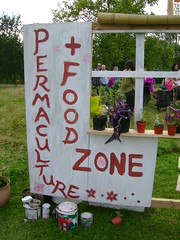
Permaculture & Food ZoneImage by London Permaculture via FlickrMimicking Nature to Feed the Masses
The second method is permaculture gardening, which is an interdependent system where a large variety of complimentary plants are strategically located for the benefit of the entire garden. This design system is brilliant for urban micro-farms, kitchen gardens, self-sufficient homesteads, and even large scale family farming. The philosophy of permaculture gardening is to recreate nature in a profound way to produce chemical-free food.
Permaculture works something like this; you design an entire edible habitat based on the natural capital of your setting. Then, place plants to methodically balance the soil, water, and pests. For instance, a nitrogen fixing plant may be planted next to a nitrogen hungry plant, which may sit next to an ornamental that deters predators, and so on. Permaculture is also a closed circle philosophy where all resources are optimized though conservation and recycling. The immense food yields per acre are astonishing when using permaculture methods and the results are also drawing many newcomers.
Many homesteaders have utilized these techniques for years before Bill Mollison coined the term “permaculture”in the 80s. However since then, the definition of permaculture has grown to encompass sustainable design systems for all aspects of our existence – agriculture, water, housing, business, community, and wellness.
Now that conventional agriculture methods that depend on cheap infinite oil are proving to be unsustainable at best, permaculture’s popularity is exploding. Numerous businesses, institutes, courses, and internships are popping up to spread nature’s gospel.
Learning about these methods has given me new-found optimism about living in a sustainable way as humanity progresses. These techniques can truly provide a future of what has been previously called an oxymoron – Sustainable Abundance.
Sustainable Abundance - love that term.  No harm gardening.
Enhanced by Zemanta